The One with the Sentence
Stewart Bewley
In any Hollywood movie there is always the very important side-kick. They are never in the limelight but they are crucial to the movie. These roles are played by Hollywood Bananas – actors that bounce around from supporting role to supporting role (Steve Buscemi, JK Simmons, Margo Martindale – check ’em out, you have seen them everywhere).
The sentence is the Hollywood Banana of your presentation. Rarely will anyone say 'That was a great sentence' but if the sentences are great, the Board may just green-light your multi-million dollar budget. If the sentences are long and waffly they may just say 'No.' Its length will define whether you are easy to listen to or whether people want to bash their heads against the wall.
Here are seven ways to create and shape your sentences that, just like the Hollywood Banana, enables your presentation to look, sound and feel easy to be part of.
1) Write short sentences
Daniel Kahneman created the field of Behavioural Science – how the brain works – and then won a Nobel Prize for it. He did a LOT of research and study and discovered that when audiences listened to long complicated sentences they didn’t want to trust the speaker. But when that speaker spoke in short sentences they wanted to trust them. They WANTED to trust them, whether the content was good or bad. So to win your audiences, you need to speak in short sentences. But how?
2) Speak your sentence out
The spoken word is meant to be that: spoken. And in short sentences. You have to write down the words first to speak them out second. Get the order right and everything goes well. Get the order wrong and you end up with long, waffly sentences. Here’s the correct order:
Write down the first three sentences of what you want to say. Then as soon as you have written down those sentences, before you go to powerpoint or Canva, speak them out. You will know instinctively which sentences sound boring and too long. Be bold and change them to something better. To help you do it ask five questions...
3) Ask the five questions
I coach on this all the time. I blog on this all the time. Because it works. If you want to take your sentences seriously you need to take the beginning, middle and end of your story seriously. Answer these questions in short sentences and you will get a strong beginning, middle and end.
1. Who is the potential hero?
It is not you, it is the audience, or the audience’s audience, the end-user
2. What is the dragon they need to kill?
A dragon will block and kill you unless you kill it. Be real about the threat.
3. What is the weapon you are going to give them to kill it?
This is where you come in and what you are presenting as an option/solution. Give lots of detail.
4. When the dragon is dead, what is the treasure?
Describe what it looks like to win the treasure. It is a good thing! Most people miss this out.
5. Now they have the treasure, what does the future look like?
The treasure changes the future.
4) Pitch your answer in one minute
Here are some words I hate: 'online platform, key stakeholders.' There are many more and they don’t belong in a 1-minute presentation. These five questions were designed for a 1-minute presentation. It rarely goes beyond that. Doing one minute means you won’t be able to waffle.
5) Play line 5 to line 1
This is by far my most favourite game EVER! Once you have spoken out your one minute, now move the end line to the beginning. Pick it up, shunt it to the front and start your presentation with it. Record it on your phone as a voice note so you can feel the difference. When you go from line five straight to line one you will be tempted to re-write. Don’t do it. This is not about re-writing. This is about knowing the power of a sentence. And your fifth sentence is powerful because you have been building up to it. It is in many ways your 'Why' sentence. But you can’t short-cut it. To get to your powerful line five you have to answer all of the questions in order. Trust me. It works.
6) Find a human
You will feel the temptation in the moment of presentation to speak longer and go back to old habits. So allow yourself to feel this temptation and to overcome it before that moment – have a rehearsal! You do that by presenting to a human. Your sentence will never buckle under pressure. Say it out loud, feel the pressure and then feel the joy of doing it.
7) Now you can build your slide deck
The business world has learnt to let the slide speak for you. Don’t do that – it can’t tell your story. The slide only ever backs up your story. So pick an image, a pie chart, a headline, three facts you want to highlight, draw a pipeline. Whatever you do it needs to back you up, not the other way round. And there you have it.
Follow these seven steps and your sentence will shine. And if your sentence shines then you will shine and that is a huge win!
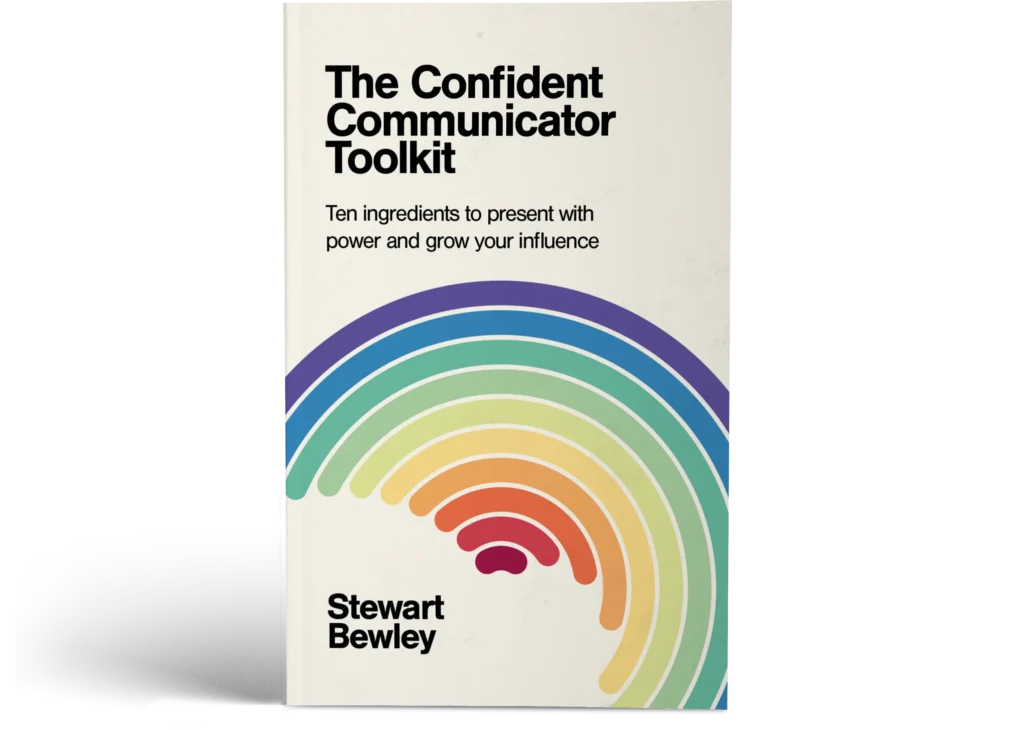
Coming Soon: The Confident Communicator Toolkit
Be the first to know when my new book The Confident Communicator Toolkit: Ten ingredients to present with power and grow your influence is released—and get an exclusive PDF download!