Seven Ways to Not Give Your Power to AI
Stewart Bewley
This month I took my family on an epic US road trip. We battled the streets of New York searching for great coffee (thank you Brooklyn Rebel Roasters), we surfed the west coast of San Diego, we took on the LA freeway to get to Six Flags Magic Mountain theme park, we climbed up stunning waterfalls on the Columbia river near Portland, and chased a grey whale (nearly) all the way to Canada!
Every day was a true adventure. And ChatGPT can probably make it read better for you. But in my line of work I care about the way you speak. Here are seven ways to make sure you speak well, speak as you and don’t give over your power of speaking to AI.
- When you present in business you will discover the unwritten rules. They go a bit like this: 'I must sound serious. I must speak in long sentences. I must reveal no emotion and no specific detail'. To break this habit I want you to write down the three things you know you do badly. Turn them into rules ('I must never smile'). Now make a choice to break them in every meeting.
- Stanford University say that a story is 22 times more memorable than a fact. Let’s start with your own 'how did I get here' story. Grab a piece of paper and draw six bubbles that are big enough to write a sentence in.
- Write down the question 'How did I get here today?' Go right back to your younger years – was there a class in secondary school where you fell in love with coding? That goes in the first bubble. When your mates were out riding their bikes were you reading books on how to create the next best business? That goes in the second bubble. Bubble six is where you are today.
- Mark Twain said 'If I had more time I would have written you a shorter story.' That is why your story needs to be 2 minutes long, not 10 seconds, and not 10 minutes. You need to feel the energy required to truly engage your voice and your audience. Find a human to speak your story to to help you do this.
- Now you have a beginning, middle and end in a 2 minute story, we’re going to apply it to business. Think of a presentation you’ve got coming up. I would like you to ask yourself the following 5 questions about your presentation and write down the answers.
i) Who is the hero?
It’s not you. You are the wise mentor who helps the hero. It might be your customer. It could be the business.
ii) What is the dragon they need to slay?
A dragon blocks people from getting where they need to go. So what is blocking your hero?
iii) What is the weapon you are going to give them?
Do you need budget to build a product? Tell them how your product will make their business more successful.
iv) What is the treasure?
What will they get if the dragon is slain? What does success look like?
v) What is the future?
What does the company look like in three years time? - Turn the answers to these questions into a 1-2 minute presentation that you will deliver. You could use this as an introduction for your next meeting.
- Speak out and record your presentation on an voicenote. Play it back. When you listen to your voicenote, notice your fifth line. You will hear yourself stronger and more confident. Move that fifth line upfront then deliver the rest of the presentation. You will be very pleasantly surprised!
- Finally, take your presentation out for a walk. As you walk past cars, dogs and humans, speak it out loud (put in some headphones so it sounds like you are on the phone). It will energise you instantly. Remember that energy and bring it into your meeting.
Do these seven things and you will truly discover your power to speak confidently. And once you know your power you won’t easily give it away to AI. I would love to know how you got in, so do get in touch and tell me!
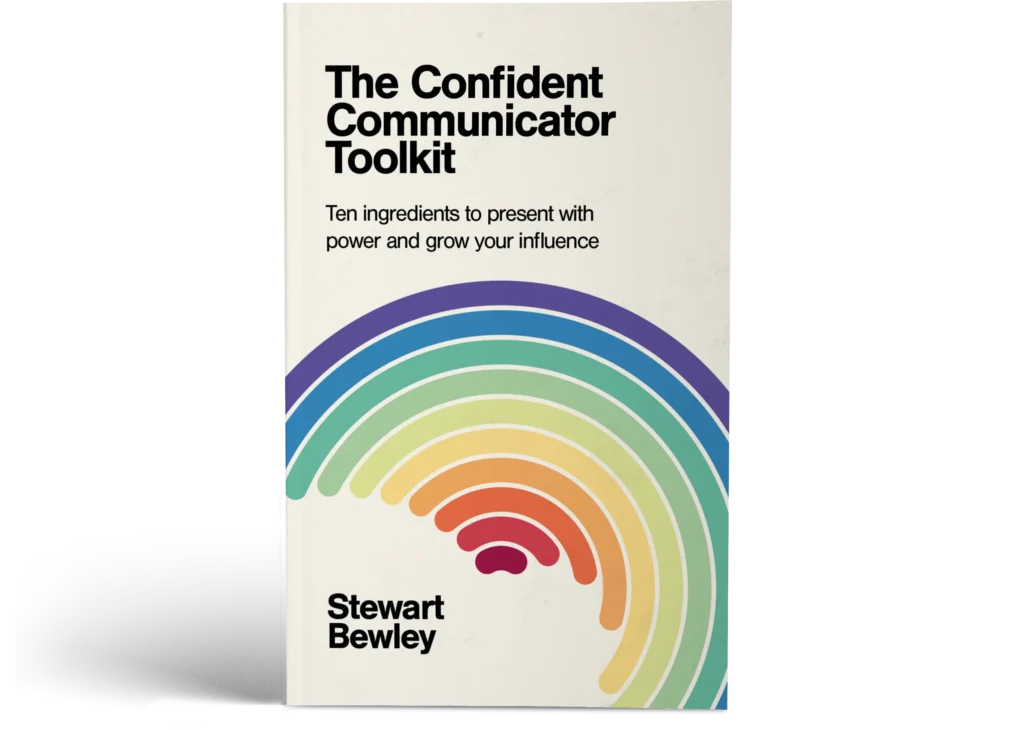
Coming Soon: The Confident Communicator Toolkit
Be the first to know when my new book The Confident Communicator Toolkit: Ten ingredients to present with power and grow your influence is released—and get an exclusive PDF download!